What Hurricane Went Out Into the Sea and Came Back Again
Hurricane Hazel
Issue Overview
Hurricane Hazel was the deadliest and costliest hurricane of the 1954 hurricane season (Figure 1) and is the strongest and but Category 4 hurricane to e'er striking the Due north Carolina coast. The kickoff indication that a tropical whirlwind had formed came on October 5, 1954 about 50 miles east of the island of Grenada in the Windward Islands. Hazel moved w over the Caribbean area Body of water through Oct 8 before sharply turning northward under the influence of an upper level low that was situated over the western Caribbean Sea. Past October 9, Hazel had intensified into a powerful Category iv storm with maximum winds of 135 mph. Between October 9th and twelfth Hurricane Hazel moved n and and so n-northeastward crossing western Haiti on October eleven leaving a death cost estimated to be between 400 and 1,000. Every bit a result of the passage over Haiti, the maximum winds macerated to 100 mph, but subsequently clearing Republic of haiti, Hazel was once more over warm tropical waters and began to strengthen.
Hazel gradually turned back northward passing over the southeastern Bahamas on October xiii, and so turned more northwestward on the 14th when hurricane hunter planes found Hazel'south maximum winds had increased to 150 mph with the center now moving at a rapid thirty mph in response to a strong upper level trough moving eastward over the Mississippi Valley. Landfall occurred on the North Carolina/S Carolina border (Effigy 2) on the morning of Oct 15th as the system was starting to transition into an actress-tropical storm.
The coastal area nigh the landfall was battered by winds estimated to have been as high 150 mph. Winds of 98 mph were measured in Wilmington while winds were estimated at 125 mph at Wrightsville Beach and 140 mph at Oak Island. A storm surge of over 12 anxiety inundated a large area of coastline reaching as high as xviii anxiety at Calabash, where the tempest surge coincided with the time of the lunar loftier tide and Hazel nigh wiped out Garden City, SC.
As Hazel moved speedily inland, its winds simply slowly diminished with a gust to 110 mph reported at Fayetteville and 90 mph at the Raleigh-Durham Airport. Air current gusts near 100 mph were reported from numerous locations in Virginia, Maryland, Pennsylvania, Delaware, New Jersey, and New York as Hazel raced northward. Myrtle Beach, SC reported a tiptop gust of 106 mph; Washington DC reported sustained winds to 78 mph while peak gusts to over 90 mph were reported far to the north in New York state. In New York Metropolis, a peak gust of 113 mph was recorded at the Battery at the south end of Manhattan.
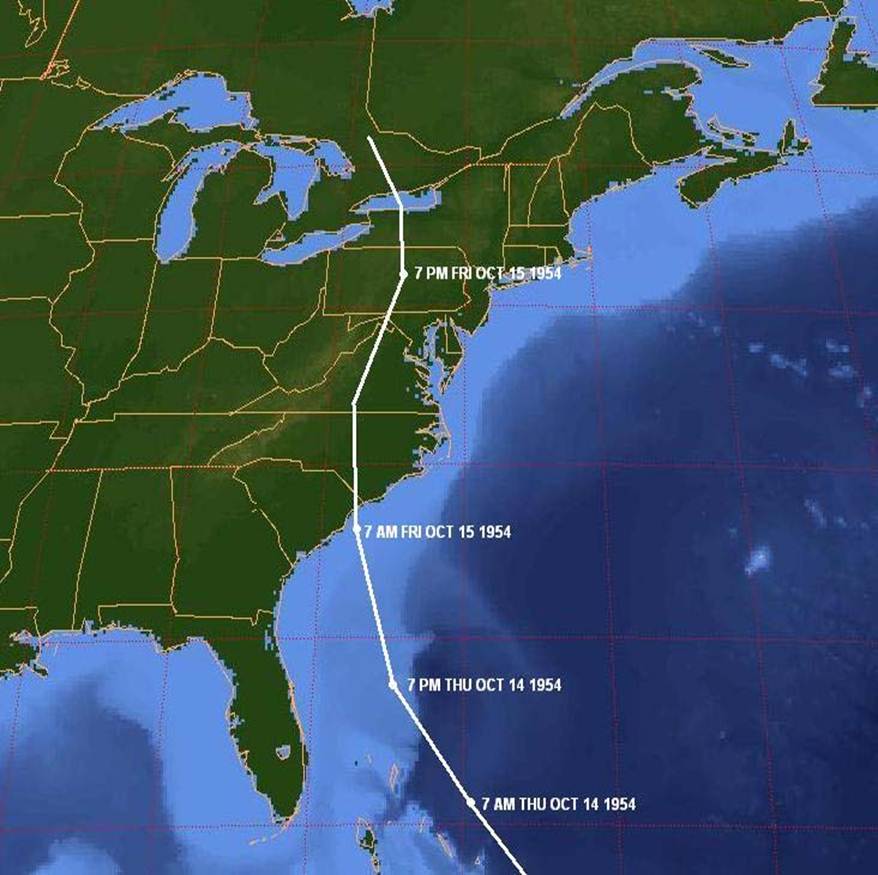 .Figure 1. Path of Hurricane Hazel, October 14-15, 1954
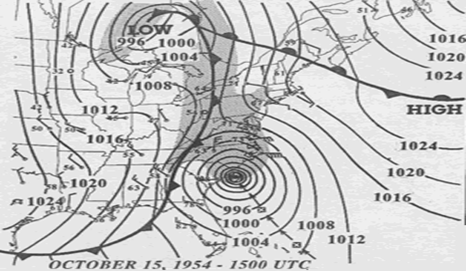
Figure 2. Surface Weather Map from Oct 15, 1954 at xi AM showing Hurricane Hazel along the Carolina declension.
Evolution and Impacts
At 11 a.m. EDT on October fourteen, 1954, The U.Southward. Atmospheric condition Bureau (precursor to the National Weather condition Service) issued a warning for the Carolinas, although the forecasters felt the eye of Hazel would remain offshore and weaken. Instead the hurricane took a northwest turn and headed toward land. Forecasts were updated to indicate landfall near the North Carolina/Due south Carolina border. Massive evacuations were ordered forth the Carolina coastal regions at this time.
Hazel made landfall as a Category 4 hurricane virtually Calabash, North Carolina, close to the North Carolina/S Carolina land border, halfway betwixt Myrtle Embankment and Wilmington. The hurricane brought a storm surge of over 18 feet to a big area of the Northward Carolina coastline, producing severe coastal damage. Intensifying the damage was the fact that the hurricane coincided with the highest lunar tide of the year. Brunswick Canton suffered the heaviest damage, where most littoral dwellings were either completely destroyed or severely damaged. For example, in Long Beach, North Carolina, only v of the 357 buildings were left standing. Equally a result of the high storm surge, the low-lying sandy barrier islands were completely flooded. The official report from the Weather Bureau in Raleigh, North Carolina stated that as a result of Hazel, "all traces of civilization on the immediate waterfront between the land line and Cape Fear were practically annihilated." The December 1954 NOAA study on the hurricanes of the year states that "every pier in a distance of 170 miles of coastline was demolished".
In Carteret Canton, Hazel done out numerous bridges and causing tremendous property damage. Tony Seamon and his father, owners of the Sanitary Restaurant in Morehead City, drove to the restaurant during the tempest and cut holes in the floor to bleed the rise h2o out of the building. Their endeavor saved the restaurant, and it was able to serve as a feeding centre later the storm.
The damage from Hazel was non limited to the coast. With Hazel having a forwards speed of as much as 55 mph at times, the Raleigh-Durham Airport reported sustained winds of 75 mph with gusts to xc mph. With such high winds state-broad, heavy damage was caused to forests, and to property every bit a event of falling trees. In North Carolina, the most rain was received in the interior of the country: Robbins received 11.3 inches of rain, and Carthage received 9.vii inches.
Nineteen people were killed in North Carolina, with several hundred more injured; 15,000 homes were destroyed and another 39,000 were damaged. Amercement in the Carolinas amounted to $163 1000000. Embankment property incurred $61 million of damage alone. Elsewhere in the eastern United States, amercement were estimated at $145 meg for a total of $308 million in losses from the hurricane.
Sources
National Hurricane Center
E Carolina Academy Athenaeum
Wikipedia
National Weather Service, Raleigh, NC
Photos (Courtesy Associated Press, Due east Carolina RENCI)
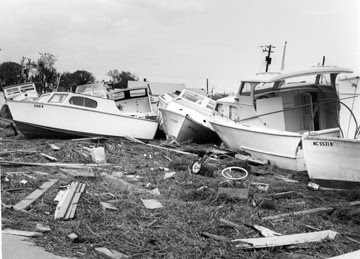
Damage near Morehead Urban center
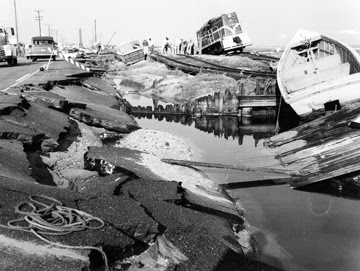
Beaufort/Morehead City Causeway Devastation
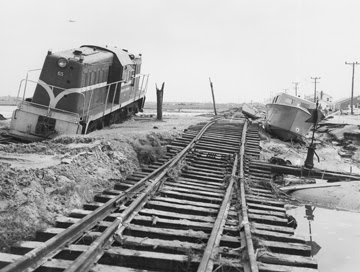
Damage near Beaufort
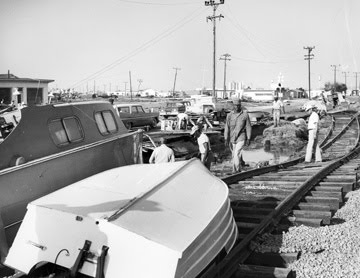
Radio Island damage
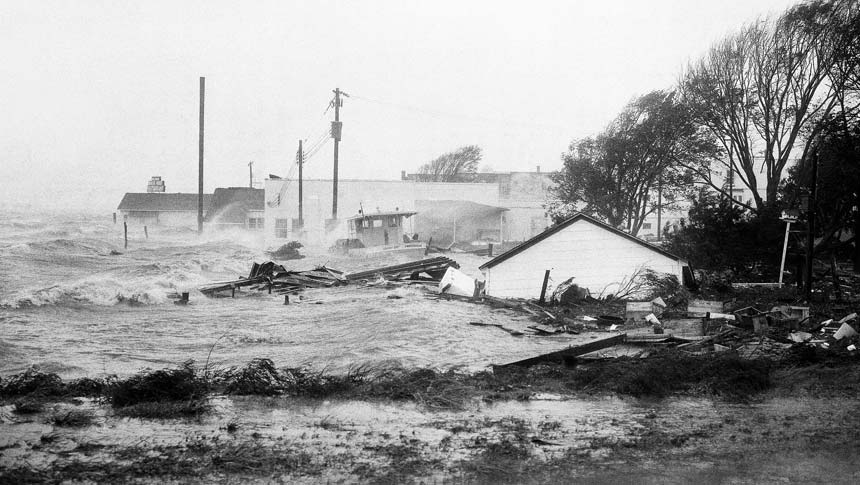
Flooding in Morehead Metropolis
Case Review Team:
Chris Collins
thompsonbettandow1937.blogspot.com
Source: https://www.weather.gov/mhx/Oct151954EventReview
0 Response to "What Hurricane Went Out Into the Sea and Came Back Again"
Post a Comment